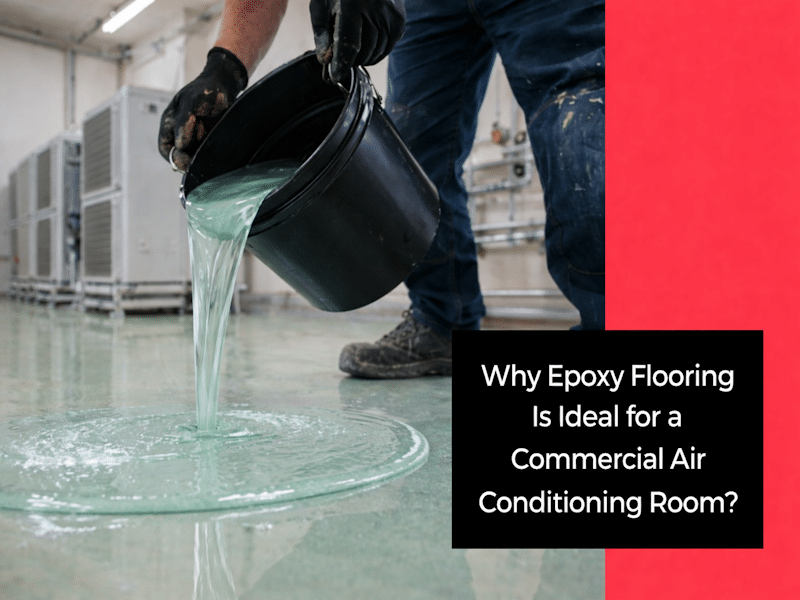
Commercial air conditioning rooms face heavy equipment loads, constant vibration, moisture from condensation, and exposure to oils and coolants. Epoxy flooring is ideal for these environments because it delivers high compressive strength, strong chemical and moisture resistance, and a durable bond to concrete. When correctly specified to the right resin flooring system and thickness, epoxy withstands the demands of HVAC and plant rooms long-term.
Key Takeaways
- HVAC and plant rooms require industrial-grade resin flooring — decorative coatings are not suitable.
- Epoxy flooring offers high compressive strength, chemical resistance, and a strong bond to concrete — making it the preferred system for most commercial air conditioning rooms.
- FeRFA RSL classifications help specifiers and facilities managers choose the right system for the load and usage environment.
- Industrial floor thickness must match the equipment weight, point loads, and expected maintenance traffic — thicker is not always better.
- Incorrect system selection is one of the most common causes of premature floor failure in plant environments.
- A specialist assessment ensures the correct epoxy system, RSL classification, and thickness are specified from the outset.
Why Flooring Matters in a Commercial Air Conditioning Room
A commercial air conditioning room is not a passive space. It houses fixed mechanical equipment, chillers, compressors, air handling units, all of which generate constant vibration, point loads, and heat. Technicians access the space regularly for maintenance. Condensation forms. Drainage is required. And over time, oils, coolants, and maintenance chemicals find their way to the floor.
In this environment, the floor is not decorative, it is a working surface that must perform reliably under sustained mechanical and chemical stress. Standard coatings applied without the right specification will fail. Cracks form. Delamination occurs. The floor becomes a maintenance issue in its own right.
This is why facilities managers, engineers, and commercial building owners are increasingly turning to correctly specified epoxy flooring systems when designing or refurbishing HVAC and plant rooms.
Where Epoxy Flooring Is Used in Commercial HVAC and Plant Environments
Epoxy flooring is used across a wide range of commercial and industrial environments. In the context of HVAC and mechanical services, common applications include:
- Commercial air conditioning rooms and chiller plants
- Building services plant rooms and rooftop mechanical areas
- Pump rooms and electrical switch rooms
- Maintenance bays adjacent to mechanical services
- Warehouse facilities with climate control infrastructure
- Industrial facilities with on-site HVAC infrastructure
What these spaces share is a requirement for flooring that can handle mechanical loading, moisture, and chemical exposure, while remaining safe for foot traffic and easy to clean.
What Are FeRFA Standards and RSL Classifications?
FeRFA, the Resin Flooring Association, is the body that defines best-practice standards for the specification, installation, and performance of resin flooring systems. Their guidance is widely referenced by engineers, specifiers, and commercial flooring professionals internationally.
Within the FeRFA framework, RSL (Resin Surface Layer) classifications categorise resin floors according to their thickness, load-bearing capacity, and intended usage environment. These classifications provide a consistent language for specifying floors, helping to ensure the system chosen is appropriate for the demands of the space.
For commercial air conditioning rooms, RSL classifications matter because they prevent under-specification. A thin decorative coating appropriate for a retail showroom is not suitable for a plant room with heavy fixed equipment and ongoing maintenance traffic. RSL classifications help specifiers and facilities managers avoid this mismatch.
Understanding which RSL classification applies to a given environment, and which epoxy system meets that classification, is a key part of getting the specification right. (Confirm with Ultimate Epoxy Floors for specific RSL classification guidance applicable to your project.)
Overview of Resin Flooring Types
Several resin flooring types are used in commercial and industrial environments. Understanding the options helps clarify why epoxy is the preferred choice for most air conditioning rooms.
Epoxy Flooring
Epoxy is a two-component system, resin and hardener, that cures to form a hard, durable surface with strong adhesion to concrete. It offers high compressive strength, good chemical resistance, and a seamless finish that is easy to clean and maintain. For internal plant environments not subject to extreme thermal cycling, epoxy is typically the most cost-effective and practical solution aligned with FeRFA standards.
Polyurethane (PU) Flooring
Polyurethane systems offer greater flexibility and thermal resistance than epoxy. They are commonly used in food production environments, areas subject to significant temperature fluctuation, or spaces where concrete movement is a concern. In a commercial air conditioning room, PU may be considered where condensation or temperature variation is extreme.
MMA (Methyl Methacrylate) Flooring
MMA systems cure extremely quickly, even at low temperatures, making them useful when downtime is limited. However, they tend to be more expensive and require careful installation. They are typically reserved for environments where rapid return to service is critical.
For most commercial air conditioning rooms, correctly specified epoxy flooring provides the right balance of performance, durability, and value.
How RSL Classifications Relate to Performance in HVAC Rooms
Not all plant rooms carry the same loads or face the same conditions. A small split-system plant room in a commercial building has different requirements to a large chiller plant serving a data centre or hospital. RSL classifications acknowledge this variation by defining floors across a range of performance levels.
In general terms:
- Lighter plant rooms with limited equipment and low maintenance traffic may be suited to mid-range RSL classifications using standard epoxy systems.
- Medium-duty HVAC rooms with fixed compressors, regular technician access, and moderate chemical exposure typically require a mid-to-higher RSL epoxy system.
- Heavy mechanical rooms with significant fixed loads, vibration, and regular chemical exposure will generally require higher RSL-rated epoxy systems with greater thickness and compressive strength.
Higher RSL-rated systems improve durability under vibration, reduce the risk of cracking and delamination, and extend the long-term service life of the floor. This matters in plant rooms where floor replacement, or even significant repair, requires equipment to be moved and operations disrupted.
Thin epoxy coatings that do not meet the appropriate RSL classification for the environment are one of the leading causes of premature floor failure in plant and mechanical rooms.
Industrial Floor Thickness: Why It Varies — and Why It Matters
Industrial floor thickness is not a fixed figure, it depends on the specific demands of the environment. In commercial air conditioning rooms, several factors influence the required thickness:
- Equipment weight and footprint — heavier equipment creates greater point loads on the floor surface.
- Vibration transfer — compressors and chillers generate sustained vibration that can stress thinner coatings over time.
- Substrate condition — a concrete substrate with existing damage, movement joints, or porosity may require a thicker build-up to achieve a sound finished surface.
- Maintenance traffic — frequent access by technicians adds wear to the floor surface over time.
- Chemical exposure — higher chemical resistance requirements may call for specific system formulations, which can affect total build thickness.
Thickness is directly linked to the RSL classification of the system and its expected lifespan. Thicker systems generally carry higher RSL classifications and perform better under sustained load.
However, thicker is not always better, or necessary. Over-specifying a floor adds cost without proportional benefit. Under-specifying leads to premature failure. The goal is correct specification: the right system, at the right thickness, for the specific environment.
Choosing the Right Epoxy System for a Commercial Air Conditioning Room
Selecting an epoxy flooring system for a commercial HVAC environment is a technical decision, not just a product selection. The key factors to consider include:
Type and Weight of Equipment
Fixed chillers, compressors, and air handling units exert concentrated loads on the floor. The epoxy system must have sufficient compressive strength to support these loads without deforming or cracking over time.
Moisture and Condensation Exposure
Condensation is a common issue in air conditioning rooms. The epoxy system must be moisture-resistant, and the substrate must be properly prepared and primed to prevent moisture-related adhesion failure.
Chemical Resistance Requirements
Oils, coolants, and cleaning chemicals used in HVAC maintenance can degrade unsuitable coatings. The specified system should be assessed for compatibility with the chemicals likely to be present.
Slip Resistance
Technicians working in plant rooms need a safe, slip-resistant surface — particularly in areas where moisture or spills are a risk. Epoxy systems can be finished with an anti-slip additive or aggregate to improve traction.
Consulting a Specialist
Each of these factors interacts with the others, and with the specific conditions of the site. A specialist assessment ensures the correct RSL classification is identified, the appropriate industrial floor thickness is specified, and the system is installed to the standard required for long-term performance.
Getting the specification right from the outset reduces the risk of premature failure, unnecessary downtime, and costly remediation. (Confirm with Ultimate Epoxy Floors for a site-specific assessment and system recommendation.)
Common Mistakes and Buyer Pitfalls
Choosing a Decorative Coating Over an Industrial System
Thin decorative epoxy coatings are designed for light-duty environments such as residential garages or retail spaces. Applying them in a commercial air conditioning room without considering the load and chemical environment is a common error — and one that leads to rapid failure.
Underestimating the Importance of Surface Preparation
Even the best epoxy system will fail if the concrete substrate is not properly prepared. Contamination, laitance, moisture, and existing coatings must all be addressed before installation. Surface preparation is not a step to cut corners on.
Focusing on Thickness Without Considering the System
A thicker floor is not automatically a better floor. Thickness must be matched to the correct system formulation and RSL classification. Specifying thickness without understanding the system’s compressive strength and chemical resistance profile can result in a floor that is thick but still unsuitable.
Ignoring Cure Times and Access Restrictions
Epoxy systems require cure time before they can be loaded with equipment or subjected to foot traffic. Failing to plan for this can result in premature loading that damages the floor before it has fully cured. (Confirm cure times and access requirements with Ultimate Epoxy Floors.)
Selecting a System Without a Site Assessment
Online product selections and generic specifications cannot account for the specific conditions of a site. A site assessment by a qualified specialist is the most reliable way to ensure the system chosen is fit for purpose.
About Ultimate Epoxy Floors
Ultimate Epoxy Floors provides professional epoxy flooring solutions for residential, commercial, and industrial spaces across Australia. Services focus on durable, low-maintenance flooring systems installed with attention to preparation, performance, and finish quality. (Confirm exact service areas if required.)
For commercial air conditioning rooms, plant rooms, and other mechanical environments, the team can assist with system selection, RSL classification guidance, and professional installation to meet the demands of the space.
Ready to Specify the Right Epoxy System for Your Air Conditioning Room?
Don’t leave your plant room floor to guesswork. Contact Ultimate Epoxy Floors to discuss your project, confirm the right RSL classification, and get a professional assessment of your site’s requirements.
Not sure which system suits your space? Speak with the Ultimate Epoxy Floors team about your environment, equipment, and performance requirements, before committing to a system.
Frequently Asked Questions
- Why can’t I use a standard decorative epoxy coating in a commercial air conditioning room? Decorative epoxy coatings are designed for light-duty environments and do not have the compressive strength or chemical resistance required for plant rooms. Commercial air conditioning rooms are subject to heavy fixed equipment, vibration, condensation, and maintenance chemicals — conditions that will cause thin decorative coatings to fail prematurely. An industrial-grade epoxy system specified to the appropriate RSL classification is required for long-term performance.
- What is FeRFA and why does it matter for my plant room floor? FeRFA — the Resin Flooring Association — sets best-practice standards for resin flooring specification and installation. Their RSL classification system categorises resin floors by thickness, load capacity, and usage environment. Following FeRFA standards helps ensure the epoxy system specified for your air conditioning room is appropriate for the demands of the space, reducing the risk of under-specification and premature failure.
- What RSL classification is suitable for a commercial air conditioning room? The appropriate RSL classification depends on the specific conditions of the space — including equipment weight, vibration levels, chemical exposure, and maintenance frequency. Most commercial HVAC rooms require a mid-to-higher RSL classification. A specialist assessment is the most reliable way to confirm the correct classification for your environment. (Confirm with Ultimate Epoxy Floors.)
- How thick should epoxy flooring be in an air conditioning room? Industrial floor thickness varies depending on equipment loads, substrate condition, and the RSL classification of the system. Thicker systems generally carry higher RSL classifications and perform better under sustained load. However, correct specification — not maximum thickness — is the goal. A site assessment will determine the appropriate thickness for your specific environment. (Confirm with Ultimate Epoxy Floors.)
- Is epoxy flooring resistant to the oils and coolants used in HVAC maintenance? Correctly specified epoxy systems offer good resistance to oils, coolants, and many maintenance chemicals. The level of chemical resistance depends on the specific system formulation. When specifying an epoxy floor for a commercial air conditioning room, the chemicals likely to be present should be factored into system selection. (Confirm system chemical resistance with Ultimate Epoxy Floors.)
- Can epoxy flooring handle the vibration from compressors and chillers? Mid-to-higher RSL-rated epoxy systems are designed to withstand sustained vibration from fixed mechanical equipment. Thinner or lower-rated coatings may develop cracks or delaminate over time under constant vibration. Selecting a system with the appropriate compressive strength and thickness for the equipment in place is essential.
- How does moisture and condensation affect epoxy flooring in a plant room? Moisture is a significant consideration in air conditioning rooms. Condensation can affect both the long-term performance of the floor and the adhesion of the epoxy system to the concrete substrate. Proper surface preparation, moisture testing, and appropriate primers are critical steps in ensuring the system bonds correctly and performs reliably over time.
- How important is surface preparation for epoxy flooring in a plant room? Surface preparation is one of the most critical factors in the performance of an epoxy floor. Contamination, existing coatings, laitance, moisture, and substrate damage must all be addressed before installation. No epoxy system — regardless of quality — will perform to specification on a poorly prepared substrate. Professional surface preparation is a non-negotiable part of a quality installation.
- How long does epoxy flooring take to cure in a commercial plant room? Cure times vary depending on the epoxy system, ambient temperature, and humidity conditions at the time of installation. Most systems require a period of curing before equipment can be reinstalled or the floor subjected to foot traffic. Planning access restrictions around cure times is an important part of project coordination. (Confirm specific cure times with Ultimate Epoxy Floors.)
- Can epoxy flooring be made slip-resistant in a plant room? Yes. Epoxy flooring systems can be finished with anti-slip additives or broadcast aggregates to improve traction in areas where moisture, condensation, or spills are a risk. Slip resistance is an important safety consideration in commercial plant rooms where technicians work regularly. Discuss slip resistance requirements with your flooring specialist when selecting a system.
- What should I ask a flooring specialist before installing epoxy in my air conditioning room? Key questions to ask include: What RSL classification is appropriate for my environment? What industrial floor thickness do you recommend? How will the substrate be prepared? What is the chemical resistance profile of the proposed system? What are the cure times and access restrictions? What maintenance is required to preserve the floor long-term? A specialist who can answer these questions clearly is well-placed to deliver a quality outcome.
- Can Ultimate Epoxy Floors assess my commercial air conditioning room? Ultimate Epoxy Floors provides professional assessments for commercial and industrial flooring projects, including plant rooms and HVAC environments. A site assessment allows the team to evaluate the specific conditions of your space and recommend the correct epoxy system, RSL classification, and installation approach. Contact the team via ultimateepoxyfloors.com.au to discuss your project.