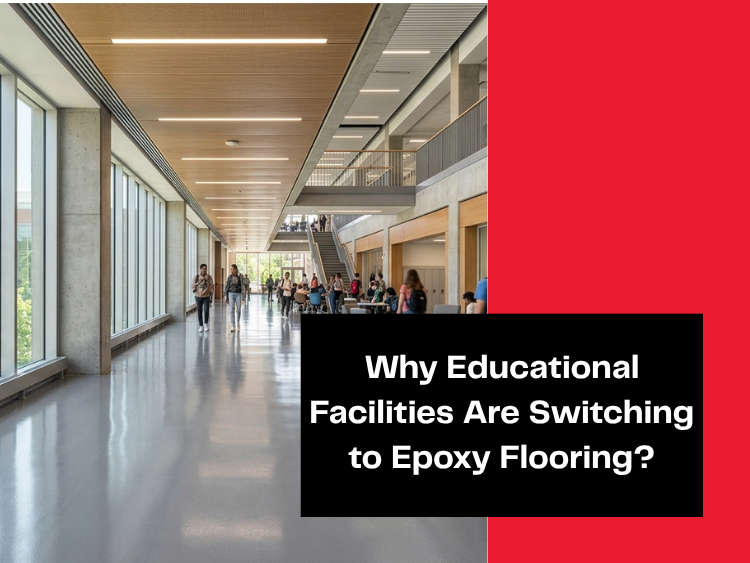
Why Educational Facilities Are Switching to Epoxy Flooring
Epoxy flooring for educational facilities is becoming the go-to upgrade for colleges, TAFEs, and training facilities across Australia. These buildings put more daily wear on their floors than almost any other type of building. Constant foot traffic, regular wet mopping, and the need for a safe, hygienic surface all add up over time. As a result, more facilities managers are specifying epoxy flooring as a practical, long-term solution. This article looks at why epoxy is gaining ground and what to consider when specifying a system for your site.
The Flooring Challenges Facing Educational Facilities
Educational buildings are heavily used daily for most of the year. Corridors, classrooms, workshops, and common areas carry a steady flow of students and staff. In addition, numbers often swell between classes. As a result, that level of use puts real strain on flooring, particularly surfaces that weren’t built to handle it.
On top of that, cleaning adds another layer of demand. Most facilities rely on regular wet mopping and commercial-grade cleaning agents. This keeps spaces presentable and helps manage hygiene across shared areas. Even so, floors need to withstand that routine without breaking down or losing their finish.
Safety is a constant consideration, too. For instance, facilities managers carry a duty of care to students and staff. Flooring plays a direct role in that responsibility, especially in areas exposed to spills, wet weather, or heavy equipment movement.
On top of all this, many institutions work within tight maintenance budgets. Consequently, reactive repairs, patchwork fixes, and premature replacement all add unplanned cost over time.
Meanwhile, traditional options like vinyl, carpet, or uncoated concrete often struggle under these conditions. For example, vinyl can lift or wear through in high-traffic zones. Similarly, carpet holds moisture and dirt, making it harder to keep hygienic. Uncoated concrete, in turn, is porous, prone to dusting, and difficult to clean properly. Overall, these limitations explain why more facilities are turning to coated flooring systems instead.
Why Epoxy Flooring for Educational Facilities Works So Well
Epoxy and polyurethane floor coatings suit high-traffic commercial environments well, which is exactly why epoxy flooring for educational facilities has become such a common specification. Educational facilities are a good example of where that performance matters most. Once installed correctly, an epoxy system bonds tightly to the concrete substrate. As a result, this reduces the risk of surface delamination associated with looser-fitting floor coverings.
In particular, these systems can provide strong resistance to abrasion, impact, and heavy daily foot traffic. For example, that matters in corridors and stairwells, where hundreds of students may pass through several times a day. It also matters in workshops or trade training areas, where staff and students regularly move equipment, trolleys, and tools across the floor.
Furthermore, epoxy handles this mechanical stress without rapid deterioration. As a result, that helps the surface hold its appearance and performance over an extended period. In addition, some spaces see a mix of foot and wheeled traffic, such as libraries, resource centres, or loading and receiving areas. In those settings, this durability is a genuine practical advantage.
Where underfoot safety is a priority, we can also specify epoxy systems with texture or aggregate additives to improve grip. This matters most in entryways, wet areas, and outdoor-linked walkways, where moisture often collects.
Safety Underfoot: What Facilities Managers Need to Know
Slip resistance is one of the first things facilities managers ask about. That’s true whether they’re considering epoxy flooring for schools, colleges, or training environments. Wet or high-traffic zones carry a real risk if the surface underfoot doesn’t suit the conditions.
Texture additives and system selection play a meaningful role here. For example, adding aggregate or a textured topcoat to an epoxy system can improve grip in areas prone to spills or wet foot traffic. This includes entrances, kitchens, science labs, and workshop wash-down zones.
Slip performance depends on the specific system chosen and how installers apply it. Therefore, it isn’t something we can guarantee as a blanket claim across every product. That said, a coating system may support relevant safety requirements, depending on the system and site conditions. This is why correct specification matters more than picking a product off a general list.
Overall, the right approach is to assess each area of the facility on its own terms. For instance, a workshop floor has different safety needs to a reception foyer. Accordingly, a properly specified system should reflect that difference rather than apply a one-size-fits-all solution.
Hygiene and Ease of Cleaning
One of the most practical benefits of epoxy flooring comes down to cleaning. Specifically, sealed epoxy surfaces are non-porous. As a result, this can facilitate cleaning and help reduce the buildup of dirt, bacteria, and other contaminants compared to porous or grout-jointed alternatives.
Because the surface has no seams or grout lines for dirt and moisture to collect in, cleaning staff can move through spaces more efficiently. This works using standard commercial cleaning routines and agents, with no need for specialised treatment or extended dwell times that some other flooring types require.
Consequently, this matters in shared educational environments, where large numbers of people move through the same spaces daily. Overall, a cleaner, easier-to-maintain surface supports a consistent hygiene standard without adding extra work for cleaning teams.
That said, we wouldn’t present epoxy as a clinical or antibacterial solution. However, the non-porous nature of a properly sealed system is a genuine, practical point of difference over vinyl, carpet, or bare concrete.
Durability and Long-Term Cost Efficiency
Facilities managers often balance upfront investment against ongoing running costs. This is where epoxy flooring for educational facilities tends to make a strong case for itself. Specifically, a properly installed floor coating can reduce the frequency and cost of ongoing floor maintenance. This matters when budgets are tight across an entire campus or training facility.
Instead of requiring recurring patch repairs, worn carpet tiles, or lifting vinyl in high-use areas, epoxy can provide long-lasting performance with appropriate maintenance. As a result, this means fewer disruptions to day-to-day operations and a more predictable maintenance schedule for facilities teams to plan around.
For instance, compare the upfront cost of a professionally installed epoxy system against the cumulative cost of reactive repairs and premature replacement on lower-durability flooring. In that light, the long-term value becomes clearer. Overall, it’s a calculation worth running properly rather than focusing solely on installation cost.
In addition, a well-maintained epoxy floor contributes to a more presentable facility environment. This matters for institutions competing for enrolments or hosting industry visits and assessments.
Installation and Minimising Disruption
Installing new flooring in an occupied educational facility comes with real logistical challenges. In fact, it’s usually one of the first concerns facilities managers raise. Consequently, surface preparation is where this matters most.
At Ultimate Epoxy Floors, we use dust-free surface preparation machinery, which contributes to a cleaner installation process. This matters most on occupied or semi-occupied sites, where airborne dust from traditional grinding methods can affect nearby classrooms, offices, or shared ventilation systems.
Because of this, we can often stage installation to minimise impact on facility operations. For example, this might mean working through school holidays or scheduling work for evenings and weekends. Alternatively, it could mean breaking a larger project into sections, so only part of the building feels the impact at any one time. Overall, the right approach depends on the size of the site and the institution’s flexibility regarding access.
In addition, experienced technicians play a significant role here too. They deliver consistent performance and minimise disruption, which is exactly what facilities teams need when they can’t afford unplanned closures or extended access restrictions. As a result, we build our educational institution flooring services around a staged, low-disruption approach for occupied campuses and training sites.
Choosing the Right Epoxy Flooring for Educational Facilities
Not every space in an educational facility needs the same flooring system. Choosing the right epoxy flooring for educational facilities means matching the product to the space rather than the other way around. For general-purpose areas like corridors, classrooms, and common rooms, standard epoxy coatings work well. In contrast, polyurethane systems tend to offer greater flexibility. As a result, they can be a better fit for areas with temperature fluctuation or heavier chemical exposure, such as science labs or trade workshops.
Alternatively, polyaspartic coatings are another option worth considering where faster turnaround is a priority. Even so, system selection should always reflect the specific use of the space, traffic volume, and cleaning regime, rather than turnaround time alone.
For example, a busy trade workshop has very different demands from a quiet administration corridor. Similarly, a wet area like a kitchen or wash-down bay needs different underfoot properties again. In particular, vocational workshops that handle heavy machinery or vehicles often require the same heavy-duty flooring systems specified for warehouses and industrial sites. This is why we tailor the selection of coating systems to the site and its intended use. We avoid defaulting to a single product across the whole facility.
Overall, the most reliable starting point is a proper site assessment with an experienced installer. During this process, they can walk through each area, understand how staff and students use it, and recommend a system that matches those conditions. In addition, many educational facilities use this stage to plan complementary work, such as line marking for corridors, car parks, or workshop safety zones. If that’s relevant to your site, we can scope our linemarking services to align with your flooring project.
Frequently Asked Questions
Is epoxy flooring suitable for school and college environments? Yes. Epoxy flooring for educational facilities suits the high foot traffic, frequent cleaning, and safety requirements found in colleges, TAFEs, and training facilities. This holds true provided installers specify the system correctly for each area.
How easy is epoxy flooring to clean in a busy educational facility? Sealed epoxy surfaces are non-porous. As a result, this can support easier cleaning using standard commercial cleaning routines and agents. Unlike some other flooring types, this flooring has no seams or grout lines that make maintenance harder.
Can epoxy flooring be installed without closing the facility? Often, yes. For example, we can stage installation to minimise impact on facility operations, such as working during school holidays or breaking the project into sections. Overall, the right approach depends on the site and its access requirements.
How does epoxy flooring compare to vinyl or carpet in educational settings? Generally, epoxy resists abrasion and heavy daily use better than vinyl or carpet. In addition, its non-porous surface can also be easier to clean and maintain to hygiene standards over time.
Does epoxy flooring meet safety requirements for high-traffic areas? Epoxy systems may support relevant safety requirements, depending on the system selected and site conditions. For instance, texture additives in wet or high-traffic zones can help. Even so, a proper site assessment is the best way to confirm what’s appropriate for your facility.
Get the Right Flooring System From the Start
Every educational facility has different traffic patterns, cleaning requirements, and safety considerations. As a result, the right flooring system depends entirely on how your site actually operates day-to-day. This applies just as much to colleges and TAFEs as it does to private and registered training organisations (RTOs). So, talk to our team about the right flooring system for your facility. From there, we’ll assess your site and recommend a system suited to your usage requirements. Get in touch with Ultimate Epoxy Floors to arrange a consultation.